Not done yet
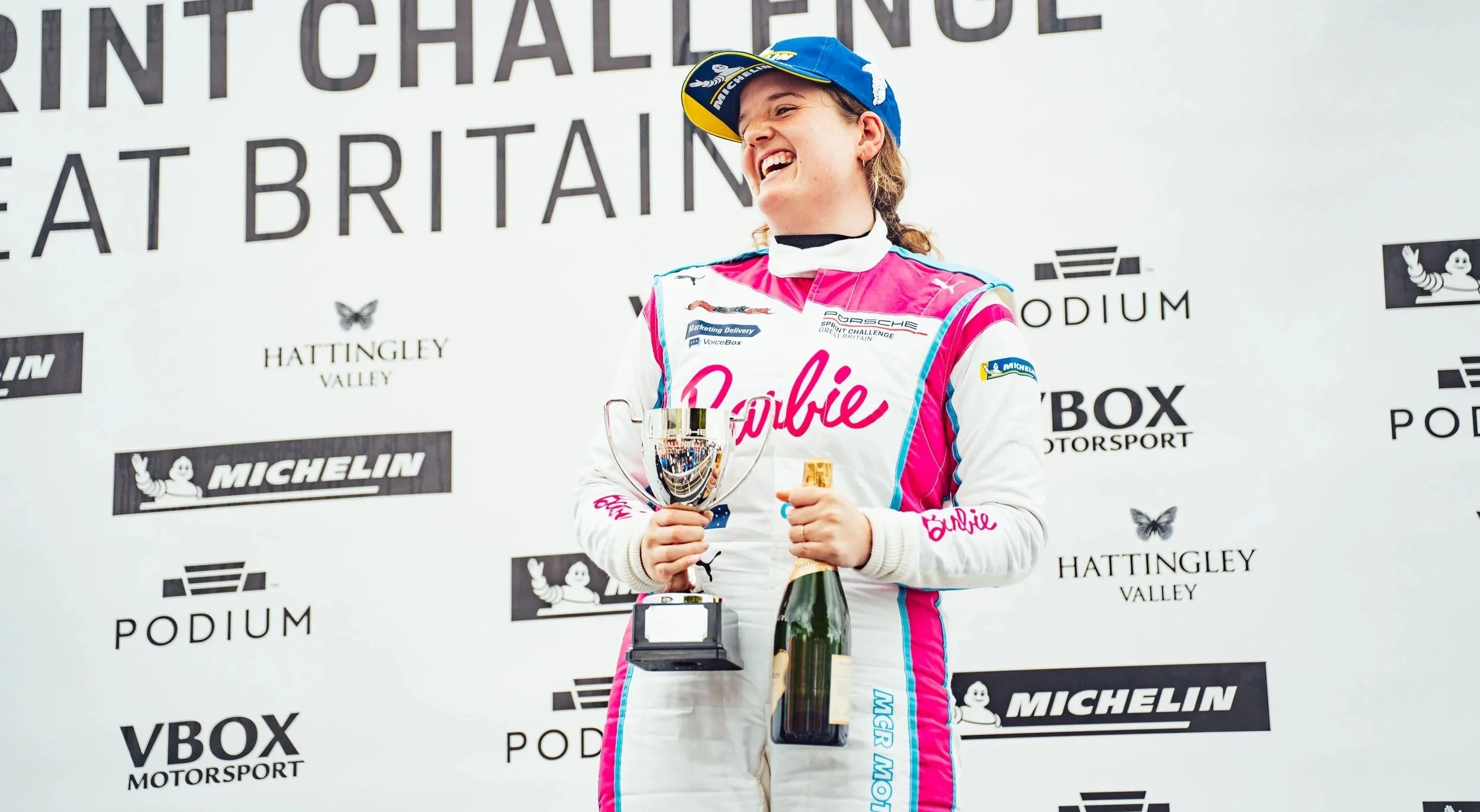
No Australian woman has raced at the 24 Hours of Le Mans since 1935. It’s a 91-year silence Caitlin Wood is determined to break.
But in elite motorsport, talent is only the starting point. Funding and mental resilience matter just as much – especially in an industry that often asks women to prove themselves twice as hard for half the respect. Caitlin has spent 10 years doing exactly that: winning at the Nürburgring, navigating the W Series, and competing in the Indian Racing League.
Speaking to The 1v1 Project, Caitlin reflects on why she’s far from finished, the reality of financial fear at 150mph, and why she views the heavy weight of being a trailblazer as a privilege.
“My toughest opponent has and will always be myself,” Caitlin admits. “The fear of failure – that I won’t achieve my goals – it’s a little scary.
“Some days I’m like, ‘Why am I still doing this?’ But I think it’s just that I’m not done yet. I don’t know what being done feels like. I hope I’m still racing at 60.”
That inner voice was born in garages where she wasn’t always welcome. But Caitlin has learned to channel the pressure – and see it as a privilege.
““Some days I’m like, ‘Why am I still doing this?’ But I think it’s just that I’m not done yet.””
Growing up racing
Caitlin’s entry into motorsport was almost inevitable. With a brother 12 years older already karting, she grew up watching from the sidelines, absorbing the atmosphere of race weekends across Australia.
“By the time I was born, he was already racing,” Caitlin explains. “I kind of just grew up in that environment. As soon as I was seven years old, the age where you can start to compete, I wanted to do it as well.”
On her seventh birthday, her dad and brother took her to Newcastle Kart Racing Club, a well-known junior motorsport track in New South Wales.
She didn’t make it past the first corner, going straight off into the gravel trap. But she loved it – and more than 20 years later, she’s never stopped.
“It just felt like something I would eventually give a go,” she says. “We ended up racing all over Australia. Other families would take their kids to play soccer or tennis. For us, we went off karting.”
As she got older – around 12 or 13 – the family approach shifted. Her dad operated on a simple principle: if you want to be the best, you’ve got to compete against the best.
He would sign her up to the most competitive series he could find.
“He threw me into the deep end quite a few times,” Caitlin remembers. “But I always survived.”
““It just felt like something I would eventually give a go. We ended up racing all over Australia.””
Leap to Europe
At 18, Caitlin faced a crossroads. She’d progressed through karting into Formula Ford, but sponsorship had dried up.
The next logical steps in Australia – the Porsche Carrera Cup or the Super2 Series – required budgets her family couldn’t afford.
But then an email arrived from Reiter Engineering, a German team offering her a place in their junior programme for the European GT4 Championship.
The incentive was obvious: win and you get a fully funded GT3 seat the following year.
Her dad sat her down at the family dinner table with a stark reality check.
“He said, ‘This is as far as we can take you. We’ve had to take out a loan to do this. Go into this open-minded. Enjoy the circuits – one’s at Spa. Try your best, but if you don’t win, that’s okay. Come home, go to university. Do the normal life stuff.’”
The implication was clear: university was a big enough challenge that Caitlin didn’t want to face it. She took the leap.
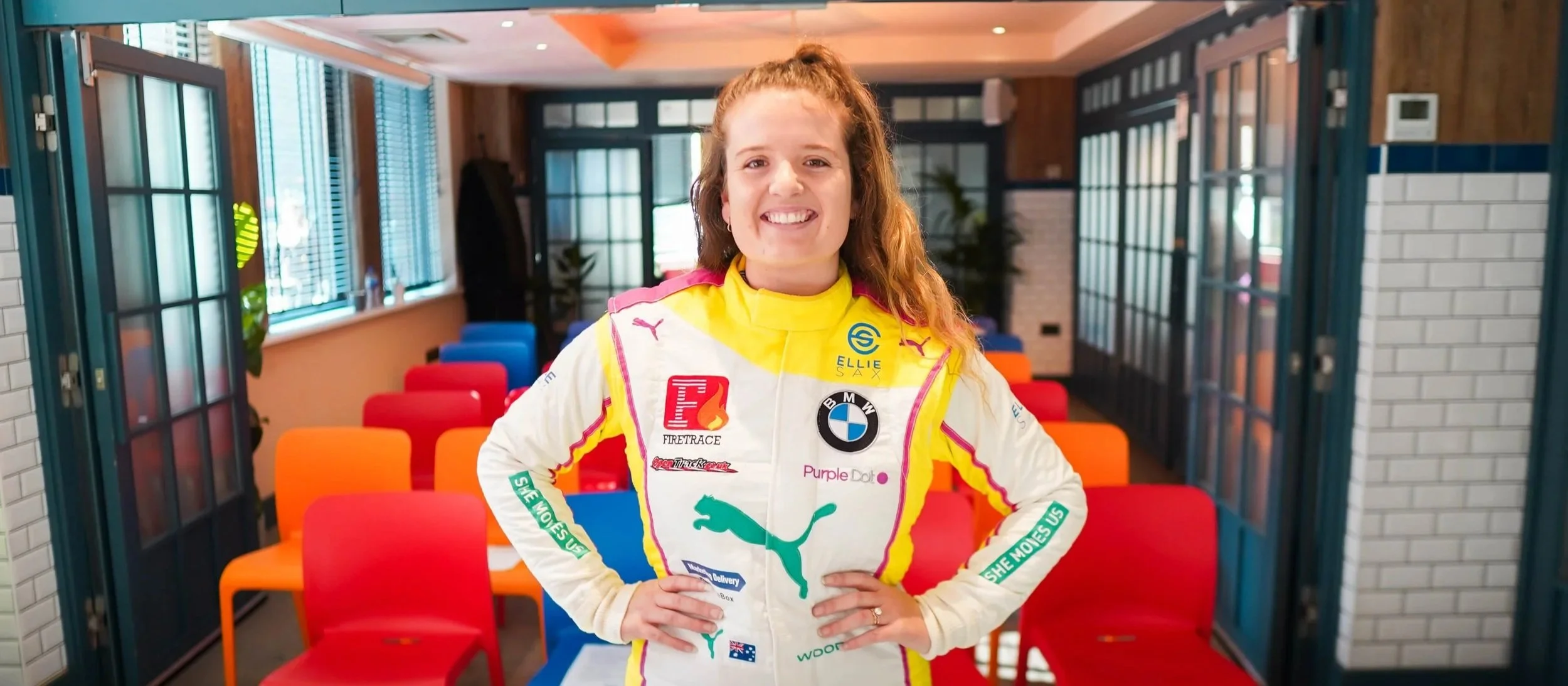
Caitlin won the scholarship programme, but moving to a non-English speaking country at 18, living alone for the first time in rural Germany, was harder than she’d anticipated.
“The amount of times I went to the grocery store and brought home turkey instead of chicken because I couldn’t read what was on the packet,” Caitlin laughs.
“It was sink or swim. I really wanted to make it work.”
She found support from Naomi Schiff – the former racing driver turned Sky Sports commentator – who was working for the team and had a spare room.
They lived together for 18 months while Caitlin embedded herself into life in Germany, taking on odd jobs around the workshop and making herself valuable beyond just her driving.
“I wanted the team to know me as a person, not only as a driver,” she explains. “Motorsport is such a collective effort. You want the mechanics and engineers genuinely invested in your success.”
Weight of money
Like many drivers competing at high levels, Caitlin’s career has been shaped as much by sponsorship as by lap times. The constant need to secure funding creates an undercurrent of anxiety that can touch every aspect of racing.
“Track testing in a real car can cost tens of thousands of dollars per day,” Caitlin explains. “So putting together a testing programme that gives value to sponsors and secures long-lasting partnerships – that’s what makes it so difficult.”
“There’s been multiple times in my career where I’ve cracked under that pressure,” she admits. “You’re driving to win. But if I have an accident, that’s a massive bill I can’t afford to pay.”
Crucially, it isn’t the physical danger that unsettles her.
““I’m not concerned about hurting myself at all. It’s the financial implications of an accident. That’s what’s scary.””
“I’m not concerned about hurting myself at all,” Caitlin says. “It’s the financial implications of an accident. That’s what’s scary.”
She knows exactly what those implications feel like. In 2022, she had her biggest career accident at the iconic Nürburgring Nordschleife.
When she returned to that same circuit in 2023, racing in wet conditions, it wasn’t just the barriers she was worried about.
“I was petrified of crashing because if I did, I couldn’t afford it,” she explains. “We just didn’t have the sponsorship or budget to cover it.
“I felt like I wasn’t performing at my best because I was so focused on bringing the car back. I wasn’t enjoying it, and I really believed I wasn’t driving well.”
Yet Caitlin more than brought the car back that weekend, carrying herself through the conditions and pressure in a way that would only later reveal its full significance.
Unintentionally making history
The Nürburgring Nordschleife – nicknamed The Green Hell – is one of motorsport’s most intimidating racetracks. Stretching 20 kilometres through Germany's forests, the circuit packs over 150 corners, dramatic elevation changes, and almost no margin for error.
“It was daunting and petrifying at first,” Caitlin admits. “There are so many different corners and it’s fast. There’s no run-off. You go off, you hit the barriers.”
She was competing in the Nürburgring Langstrecken-Serie, a German endurance series for production cars, behind the wheel of a BMW 3 Series in the middle tier – a class that tests drivers’ precision, focus and skill in managing both faster and slower traffic while maintaining concentration for hours.
“It’s definitely really challenging,” she says. “But once you get it, and you work past the challenges of learning the circuit, it starts to feel really cool.”
From that rain-soaked weekend that tested her mentally and financially, Caitlin emerged with a special achievement: becoming the first Australian woman to win a class at the circuit.
“After the race, I was wondering who had done it before me,” she says. “I went through all the records trying to find an Aussie woman. It turns out it was me.
“That was pretty cool to accomplish. Even if it was unintentional.”
““After the race, I was wondering who had done it before me. I went through all the records trying to find an Aussie woman. It turns out it was me.””
Le Mans dream
Caitlin’s ultimate goal is brutally simple and devastatingly difficult: competing in the 24 Hours of Le Mans.
Only one Australian woman – Joan Richmond in 1935 – has ever competed there. More than 90 years later, Caitlin wants to change that.
What draws her to endurance racing is the collective challenge – the way everything has to come together across a team to bring success. She describes 24-hour races as addictive – chasing the high of everyone working in perfect sync towards the same goal.
“It’s not just about you as a driver,” Caitlin explains.
“It’s your teammates, your mechanics, your engineers, the car, the weather, the traffic. There are so many changing variables all the time. It’s such a mountain of work to overcome.
“Everybody just wants to be the best at their specific role,” she adds. “The mechanics want a really good pit stop. I want the best spell. There’s something really special about achieving that together.”
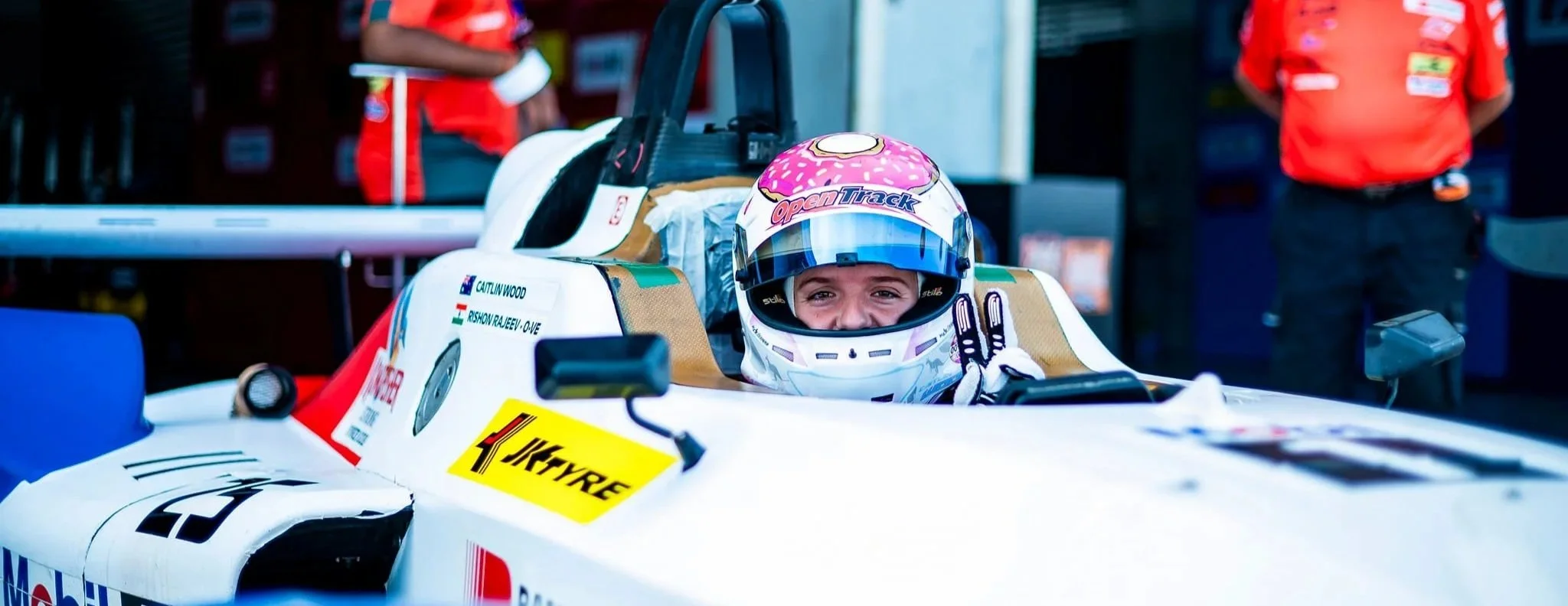
In short, endurance racing isn’t about raw speed. It’s about conserving tyres, fuel strategy, traffic management, and maintaining concentration through the night.
“You can get mentally fatigued long before you get physically fatigued,” Caitlin notes. “Your mindset is really important. You have to be pretty locked in.”
But the reality is that budgets to compete in the 24 Hours of Le Mans are enormous. Even outside the top Hypercar category, independent drivers like Caitlin face huge costs.
In LMGT3 – the production-based supercar class – a single seat can cost at least six figures, meaning the race often begins in the boardroom long before it reaches the track.
“If I won the lottery or secured a really good sponsorship partner in the next few weeks, I could probably get my way to Le Mans reasonably easily,” she explains. “The biggest factor for a lot of drivers is that financial support.”
““The mechanics want a really good pit stop. I want the best spell. There’s something really special about achieving that together.””
Proving ground
Without that funding secured, Caitlin has spent the past eight years proving herself in another arena. Living in the UK and working as a racing driver coach and instructor alongside her competitive career, she’s often been the only woman in the room.
She’s had men refuse to get in the car with her because they “didn’t want the girl.” She’s been talked down to, dismissed and underestimated countless times.
“I’ve had to earn my stripes a lot to gain the same amount of respect as the next guy who came in,” Caitlin says.
“I’ve had multiple situations where they’re like, ‘Oh, I’m stuck with the girl.’ And I’m like, ‘Just get in and shut up.’ We’re not gonna get along on those terms. It was difficult at first, but I’ve had the chance to process and learn from it.”
With her husband’s encouragement, Caitlin began to shift her perspective. Instead of seeing every interaction as a battle, she started seeing these moments as opportunities to open minds.
““And I’m like, ‘No shit, mate. I’ve done the same training and been here just as long as everyone else.’””
“If you can change their outlook, it’s another person that has shifted their mindset to believe that women do belong in this industry,” she explains. “So now I treat it as a challenge. When someone’s been disrespectful, I do my best to prove them wrong.”
Ninety-nine percent of the time, by the end of a session, the same men who doubted her are saying, ‘Wow, you’re actually really good.’
“And I’m like, ‘No shit, mate. I’ve done the same training and been here just as long as everyone else. But thank you, I'll take it.’”
Having to win over every doubter, one session at a time, is exhausting work. But one philosophy has kept her going: hard work doesn’t have a gender. And if that’s what it takes, she’ll outwork anyone.
“You can’t run away from hard work,” she says. “It doesn’t matter who you are. That’s how I was brought up – hard work outweighs it all.”
Opening doors
In 2024, Caitlin became a Barbie Sports Ambassador, partnering with the iconic brand to promote women in motorsport and STEM (science, technology, engineering and mathematics) careers.
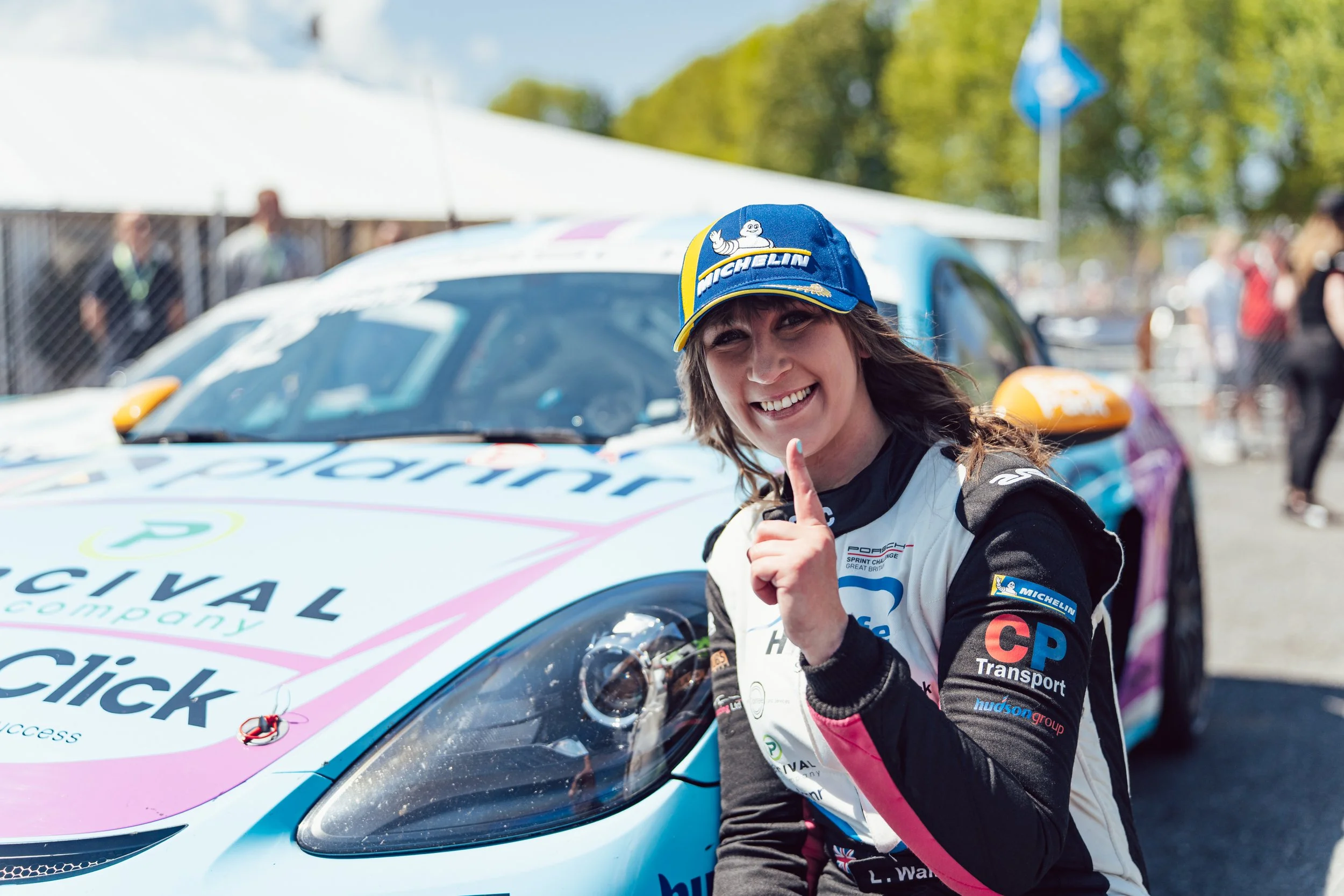
She raced in the Porsche Sprint Challenge GB championship in a distinctive pink livery, invited girls to race weekends, and visited universities to showcase the range of careers available in motorsport.
“They weren’t all only interested in driving,” Caitlin notes. “I met girls who wanted to learn more about what an engineer does, what a mechanic does, what a journalist does. There are so many different roles for women in motorsport.”
It’s work that matters to her deeply – not just for the girls she meets, but for the bigger picture.
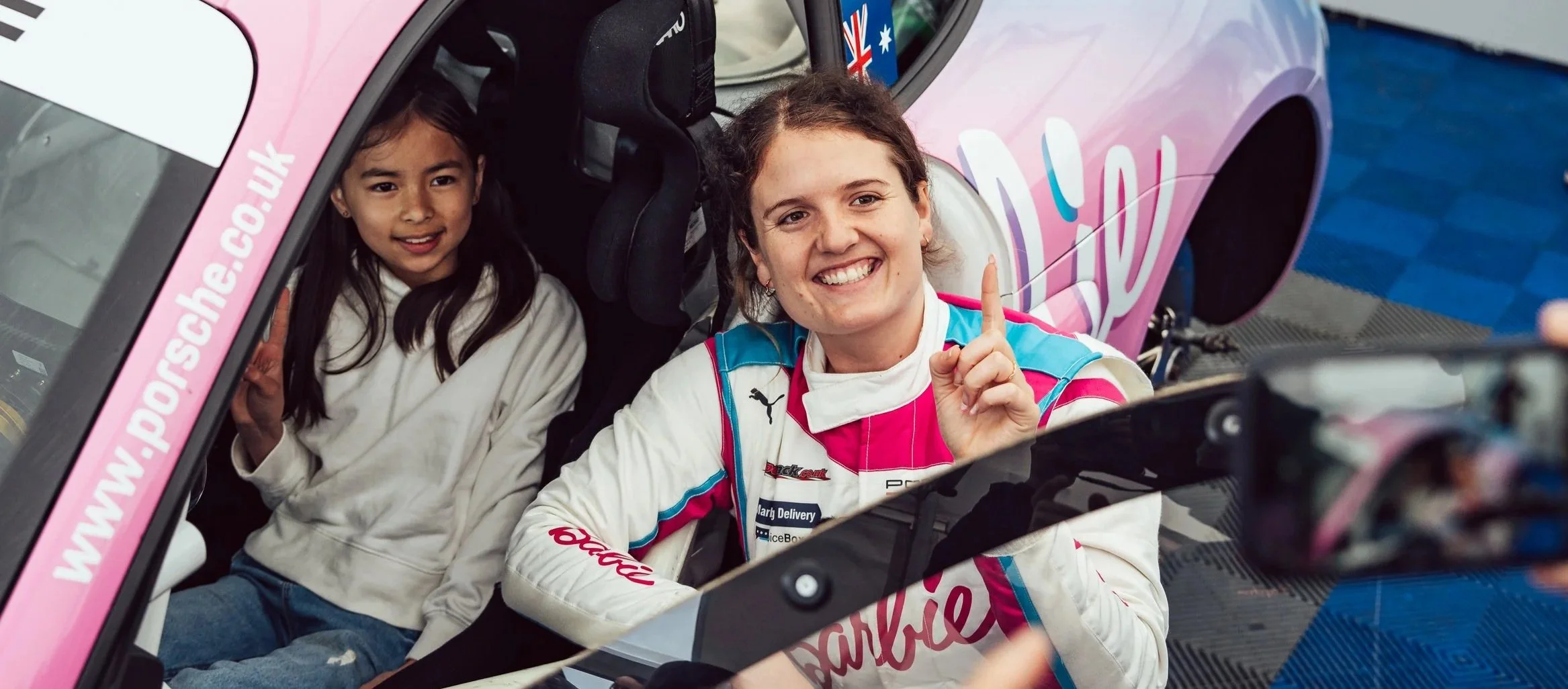
“In 2025, out of the 100 highest-paid athletes around the world, how many do you think were women?” she asks. “None. None were women.”
That statistic shapes her motivation. If young girls don’t see women succeeding at the highest levels, why would they pursue those careers?
“I want girls and women to see themselves reflected in an industry and a sport they might not have ever thought of,” she says. “That’s a really important part of my career – to work with businesses that want to see change.”
Some of those university students have reached out since, telling her they’ve pursued paths in motorsport they once didn’t know existed.
“Even if it’s only one or two young girls who have been impacted so far, it’s still two lives changed,” Caitlin says.
““I want girls and women to see themselves reflected in an industry and a sport they might not have ever thought of.””
Unfinished business
But opening doors for others required first understanding those that had been closed to her. As a young girl in motorsport, Caitlin struggled to understand why her gender sometimes mattered more than her talent.
“I’d be like, ‘Dad, why are they using my gender against me? Why does being a girl matter?’” she remembers. “That was tricky for any young person to navigate.”
Throughout her career, Caitlin has consequently struggled with imposter syndrome – that nagging feeling that maybe she doesn’t belong. It doesn’t just add pressure – it multiplies it.
The biggest shift has been learning to reframe what that pressure means.
““Having that pressure in the first place is a privilege. It means you’re pushing boundaries.””
“Pressure can feel really overwhelming and loud,” Caitlin says. “Sometimes it’s being the only girl walking in the room. Sometimes it’s feeling like you have to work twice as hard to achieve the same respect.
“But having that pressure in the first place is a privilege. It means you’re pushing boundaries. If nothing needed to change, the pressure wouldn’t be there.”
Despite a decade of navigating new countries, sponsorship battles and respect, the passion for racing burns as bright as it did at seven years old.
The sport has kept Caitlin humble, motivated and challenged. And there’s still that fire in her belly: the desire to prove people wrong by proving herself right.
It’s a fire she ultimately hopes to ignite in others. That’s why her message to the next generation is clear.
“If you’re not enjoying yourself, it’s probably not for you,” Caitlin says. “And remember, hard work doesn’t have a gender.
“You can outwork anybody.”